
Walton County Supervision Types
Florida divides the decision and field roles. The Florida Commission on Offender Review, or FCOR, decides parole and several other release matters within its authority. The Florida Department of Corrections, or FDC, carries out state community supervision. A sentencing court imposes probation and signs later orders that change or end it. This split explains why a Walton County court file, an FCOR action, and an FDC status can all matter to one person.
Probation is usually a court-ordered community sentence or one part of a split sentence. Parole is discretionary release for a narrow group sentenced under older Florida law. Conditional release is a distinct post-prison form of oversight administered under section 947.1405. None of these terms means the person is still inside Walton County Jail or Walton Correctional Institution.
A county-jail release can lead to county probation, state supervision, or no supervision at all. The booking record alone may show that a person left, but it does not define every duty that follows. Start with the signed sentence or release order. Then use the FDC detail for state field status and location. If the court order places the person with Walton County Probation, use that office instead. This sequence avoids assigning state parole to a county probation case or calling an FDC conditional-release term ordinary probation.
| Status | Who sets it | Best public check |
|---|---|---|
| Probation | Sentencing court | FDC supervised search and court order |
| Parole | FCOR | FDC supervised search and FCOR record |
| Conditional release | FCOR under Florida law | FDC supervised search |
| Discharged | Court, FCOR, or FDC as applicable | Termination status plus final order |
- Supervision
- Rules and reporting duties that apply while a person lives in the community.
- Discharge
- The formal end of custody or supervision, as shown by the controlling record.
- Absconder
- A supervised person who has stopped making himself or herself available to the supervising agency.
- Termination date
- The date supervision is scheduled or recorded to end, subject to later action.
Check Walton County Post-Release Supervision
The FDC Supervised Population Information Search is the primary public route for state supervision. It accepts a known DC number or a name, with an alias option. A correct detail can show the type, status, location or office, and termination information. FDC reports a complete weekly refresh, while location changes and termination dates update nightly.
- Search the six-character DC number when known. Otherwise enter the full name and keep alias searching available.
- Match identity with more than the name. Compare the photograph, DC number, birth information, and case details shown.
- Read the supervision type and status exactly. Do not substitute “parole” for probation or conditional release.
- Check Current Location. Supervision can transfer, so the Walton conviction or release site does not fix the present office.
- Compare the termination entry with the Walton Clerk docket or signed order when formal proof is needed.
The official search interface shows why name, DC number, and current location must be read together. View the FDC supervised search source before using its fields.
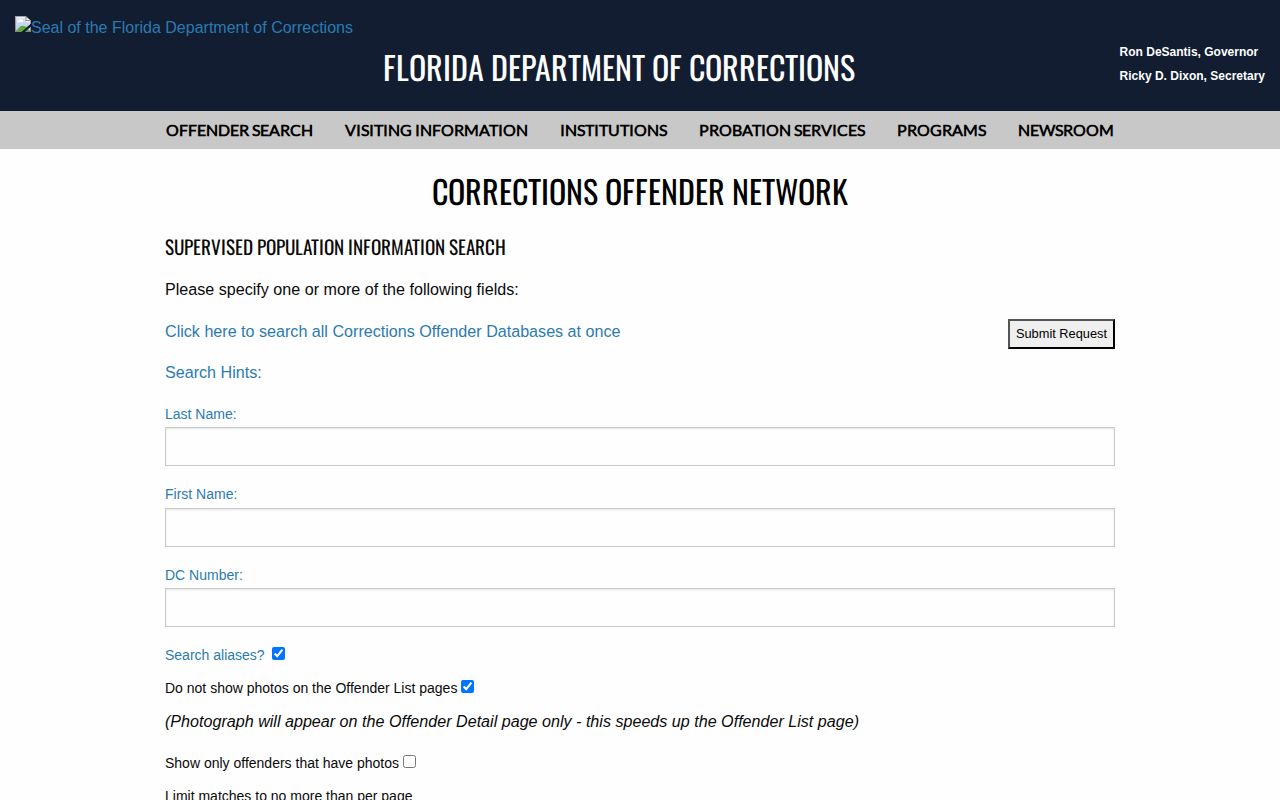
This statewide record follows a supervised person across county lines and is more reliable than assuming the office from the place of conviction.
Note: A released status and an end-of-supervision status answer two different questions and may have different dates.
Walton County Supervision Office
FDC places Walton County in Region 1’s Pensacola Circuit. Its directory lists office 014, DEFUNIAK. That office is a useful local contact only when the current FDC detail points there. Interstate moves and transfers within Florida can change the assigned office, so call the location shown in the current record rather than relying on an old order.
FDC Office 014, DEFUNIAK2338 Highway 90 West
DeFuniak Springs, FL 32433
(850) 892-8075
Fax: (850) 892-8084
Statewide questions about probation or parole field data go to FDC Probation and Parole Field Services at (850) 717-3444 or co-supervision@fdc.myflorida.com. County-court supervision is separate. Walton County Probation lists 571 E. Nelson Avenue, Suite 201, DeFuniak Springs, (850) 892-8135, on weekdays from 8:00 a.m. to 4:30 p.m. Check the court order before choosing between those offices.
The FDC Pensacola Circuit directory supplies the current local listing.
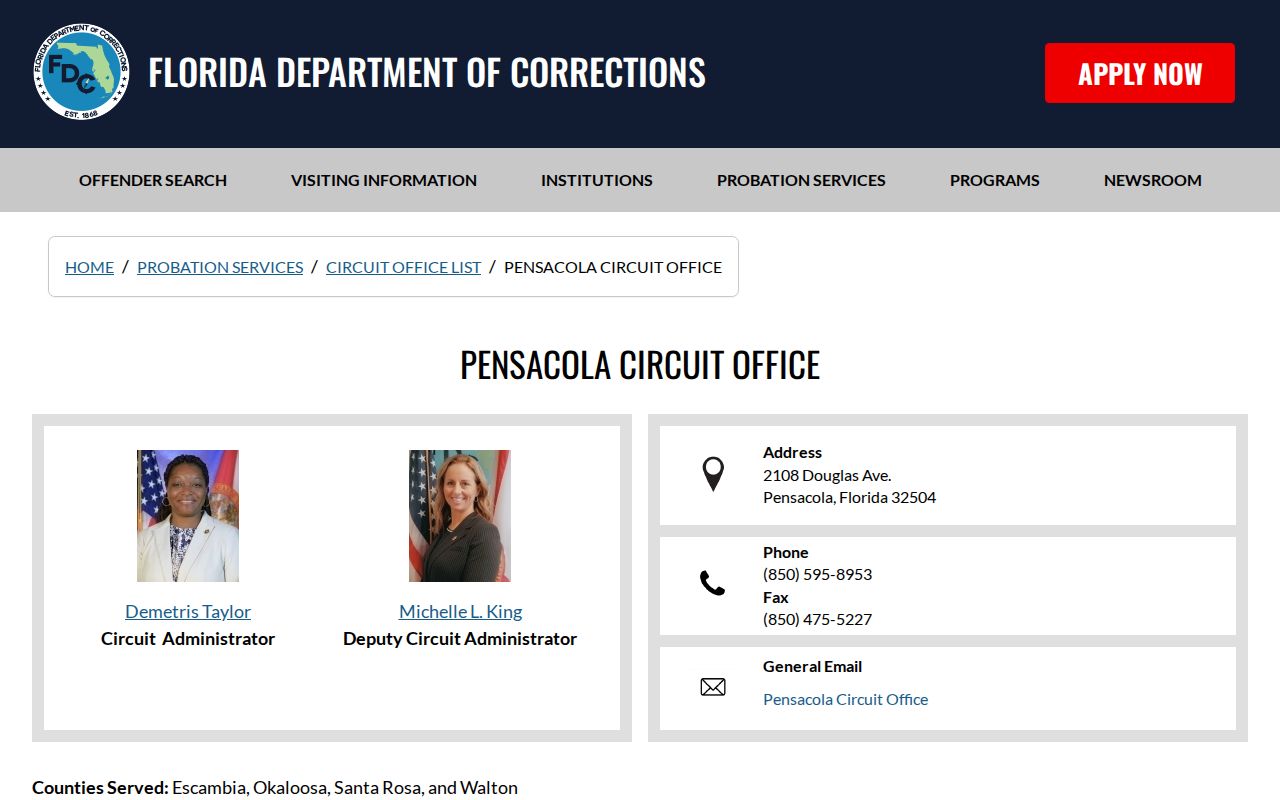
The directory should be paired with the person’s Current Location because the local address alone does not prove assignment.
Walton County Absconder Records
An absconder is not the same as a person who completed supervision. FDC maintains a separate Absconder and Fugitive Information Search. A match means the agency reports that the person stopped making himself or herself available for field supervision. It is a supervision alert, not proof of present jail custody.
FDC’s Absconder Unit can be reached at (850) 717-3475 on weekdays from 8:00 a.m. to 5:00 p.m. The public record should still be confirmed with the reporting office. A wanted-person entry also needs agency confirmation because a warrant may have changed since the database update.
The FDC absconder source provides a distinct search form.
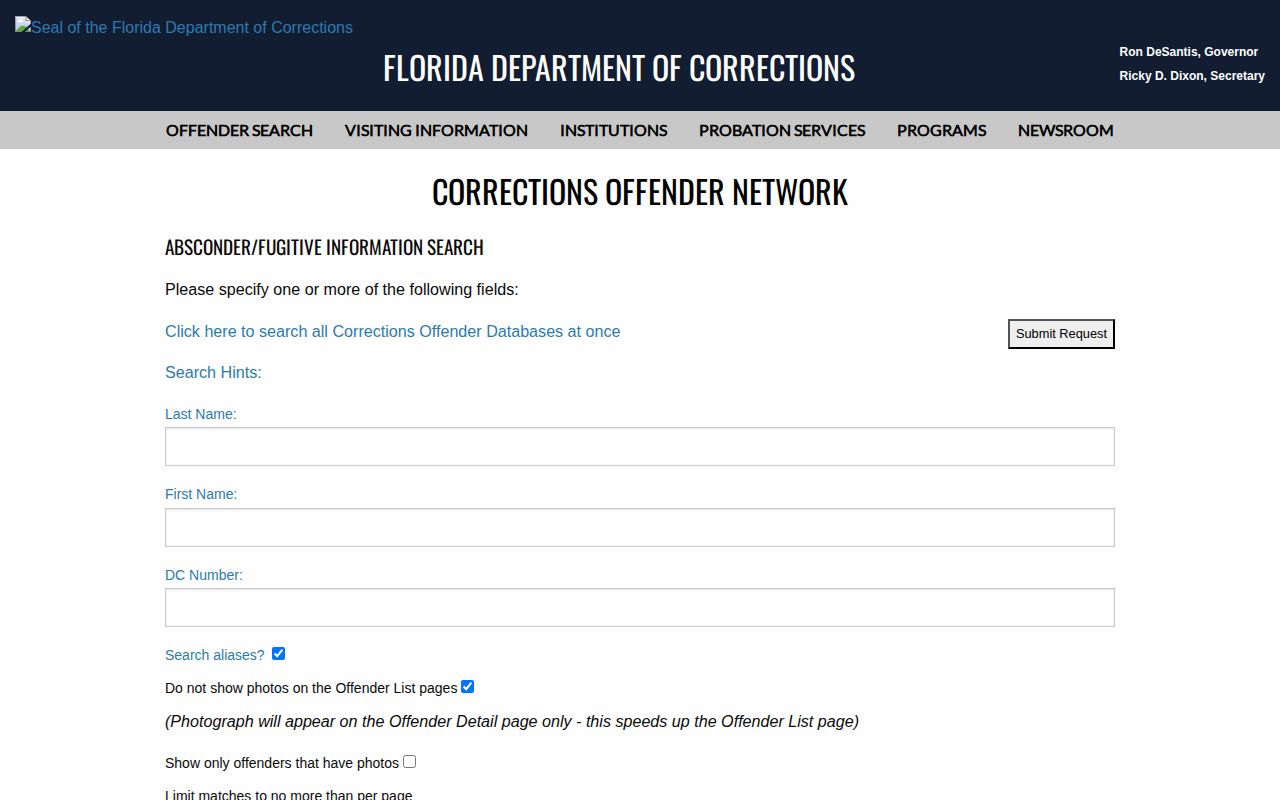
Keeping absconder data separate from the supervised-population result prevents a missed report from being mistaken for a lawful discharge.
Walton County Parole Decisions
Parole eligibility is rare in modern Florida. Chapter 947 governs the process, while Florida largely ended parole for offenses committed on or after October 1, 1983, subject to narrow exceptions. Sentence length alone cannot show eligibility. FCOR’s eligibility material and the person’s actual case era control.
An initial interview, a presumptive parole release date, an effective parole release date, and physical release are not interchangeable. FCOR schedules may list a review without giving its result. The FCOR hearing schedules help locate a proceeding, while final action may require the indexed order or a Commission Clerk request. After release, FDC’s supervised record identifies the field status.
Chapter 947 also covers several actions after a release decision. FCOR can review supervision, address a revocation matter, clarify an earlier action, or consider discharge where authorized. A calendar category describes the matter before the Commission, not its outcome. When a schedule lists a Walton County case, match the DC number and case details, then obtain the final order before stating what happened. The Commission Clerk can provide an order when no simple results list answers the question.
Note: Eligibility for an FCOR interview does not establish that parole was granted or that a release occurred.
Confirm Walton County Supervision Discharge
Supervision ends through a formal termination or discharge, not through silence in a search result. For probation, a signed Walton Clerk order terminating probation is strong court-side proof. FDC’s termination status supplies the corrections-side record. If the two differ, preserve the order and ask the Clerk and FDC office to reconcile the dates.
A no-result can stem from spelling, an alias, an old record, or use of the wrong population search. Check the FDC release record for a state prisoner and the WCSO booking history for a county-jail departure. The full county release route is described on the Walton County released inmates search. Federal supervised release is handled through the federal court and probation system, not FDC.
Conditions and violations are case-specific. Public records may show a violation filing, revocation matter, or changed termination date. They should not be used to guess what rule applied. Read the actual order and contact the listed office when a status affects a court or notification need.
Ending incarceration is therefore only one point in the record trail. The jail or FDC release record confirms departure from custody. The supervised-population record shows whether field oversight continues. A later termination entry or signed order confirms the end of that oversight. Keeping these three events separate matters when a person was released to probation, moved to parole, or completed a conditional-release term. It also prevents an expired projected date from being treated as proof that all correctional authority ended.
After Walton County Release
Post-release records can intersect with practical jail matters. The Walton inmate handbook says stored property pickup must be arranged with the jail, requires identification and a signature, and generally must occur within 60 days after release. Published scheduling is Monday through Friday from 8:00 a.m. to 4:00 p.m. Call the jail before traveling because pickup steps can change.
WCSO also documents purpose-neutral identification services through Pathways and Florida Licensing on Wheels. Those services concern documents at or after release. They do not prove that probation, parole, or another form of supervision ended. The FDC or court record remains the source for legal status.
Property pickup and supervision reporting also use different offices. Walton County Jail can explain stored-property procedure, but jail staff do not replace the assigned probation officer or FCOR record. Bring the identification required for pickup and keep the current supervision contact at hand. If a reporting date and a property appointment conflict, contact the supervising office for case-specific direction rather than assuming the jail visit changes a legal duty.