
Walton County Release Date Labels
Walton has two prospective-date systems. The WCSO Inmate Inquiry calls the county-jail field Scheduled Release Date. FDC calls the current state-prison field Current Release Date, while section 944.275 uses tentative release date for the calculation behind it. Each points forward. WCSO Release Date and the FDC release database’s Date Out-Custody point backward to an event that has occurred.
A person may leave Walton County Jail because of bond, a court order, sentence completion, transfer, or another disposition. Transfer ends that booking but does not prove community release. Likewise, movement from Walton Correctional Institution to another FDC unit is not release. The destination and status must be read with the date.
The date labels also answer different stages of one case. A Scheduled Release Date can help plan a later check, but it may remain blank or be overtaken by court action. An FDC Current Release Date reflects the state sentence computation at the time shown. Once custody ends, the historical release field becomes the stronger source. Preserve each agency’s wording because changing “scheduled,” “current,” or “tentative” to “released” changes the meaning of the record.
| Record | Prospective field | Historical confirmation |
|---|---|---|
| Walton County Jail | Scheduled Release Date | Release Date and disposition |
| FDC current prisoner | Current or tentative release date | Release record and Date Out-Custody |
| Walton court | Sentence, bond, or release order | Docket and signed order, paired with custody record |
Lookup Walton County Release Dates
Begin with custody type. The WCSO Inmate Inquiry covers county bookings. Its default In Custody box is for people currently jailed. A named person’s result can show Scheduled Release Date. For a sentenced state prisoner, use the FDC Inmate Population Search. Search by DC number when possible, then compare the person’s identifiers before reading Current Release Date.
- Identify the holding system. Walton County Jail, Walton Correctional Institution, and Walton Work Camp do not share one release-date calculation.
- For the jail, search the exact name, subject number, or booking number. Open the right booking and read Scheduled Release Date if populated.
- For a state prisoner, use the six-character DC number or name and aliases in FDC’s current-population search. Open the correct detail.
- Check the court docket when bond, sentencing credit, a new order, or a pending case may affect the date.
- After the proposed date, verify WCSO Release Date or search FDC Inmate Release Information.
The current FDC search shows the fields used before a state-prison discharge. Review the official FDC population search before relying on a result.
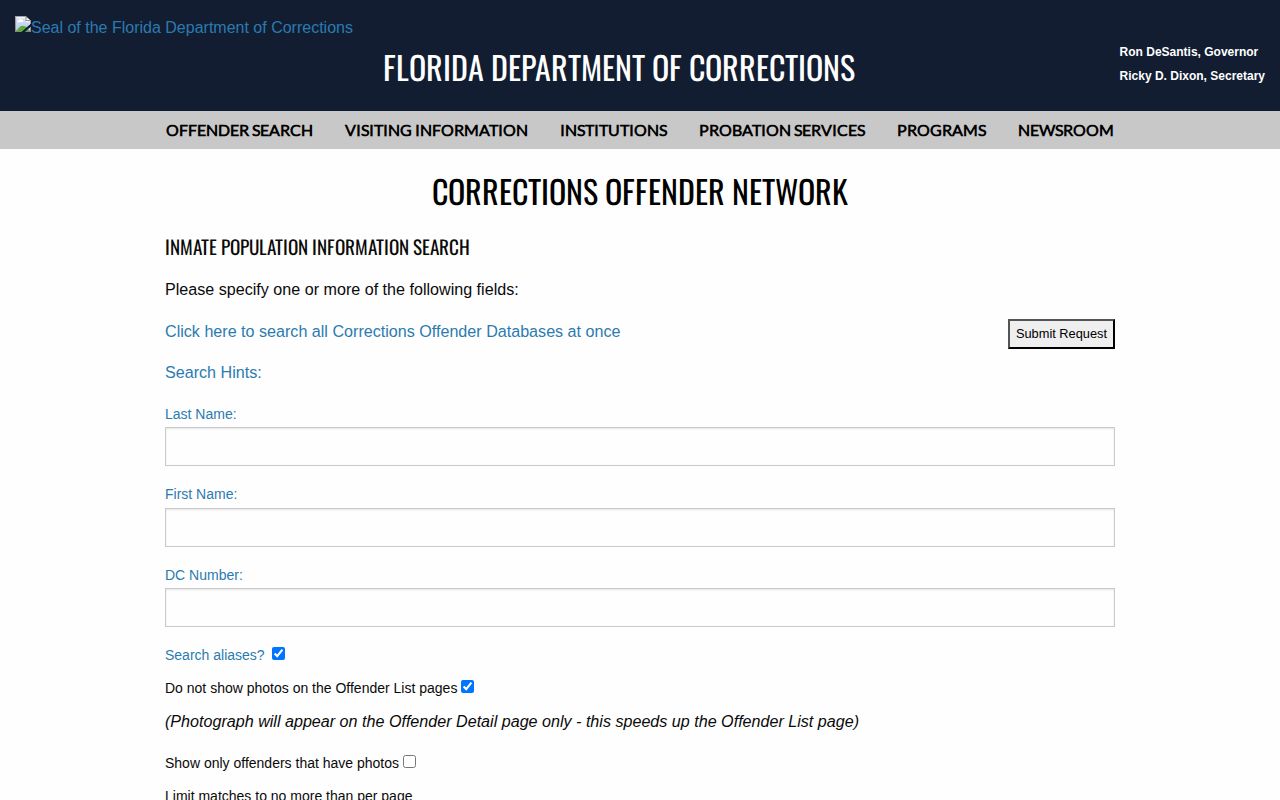
The statewide form is appropriate for an FDC prisoner, not a person held only on a Walton County booking.
Note: A blank future date can mean review is pending; it does not prove immediate release or an indefinite sentence.
Walton County Pretrial Release Dates
A pretrial detainee often has no computed sentence end date. The release may depend on bond, a judge’s order, dismissal, another case, or a hold from another agency. WCSO may display a Scheduled Release Date, but that field should not be estimated from the booking date. Read the charge, bond status, court date, and docket.
The Walton Clerk search can show a bond or release order, yet a court order alone does not prove when jail discharge processing finished. Another warrant or detainer may still control. Pair the signed order with the WCSO booking detail. If the public fields conflict, call Walton County Jail at (850) 892-8196 or request the booking and release record.
A detainer is a request or authority that can keep a person for another agency. A Walton Release Date followed by FDC intake, federal custody, or immigration custody is a handoff. It should never be described as freedom without checking the receiving system.
County sentences also differ from pretrial holds. A sentenced jail inmate may have a schedule based on the court term, jail credit, and local gain-time policy. Someone awaiting trial may leave sooner through bond or later through a new court ruling, with no fixed sentence calculation in between. When several cases appear in the Clerk docket, review each active matter because one release order may not dispose of another hold.
Florida Prison Release Calculations
For a term-of-years state prisoner, FDC begins with the maximum sentence expiration date and lawful custody credits. Under Florida Statute section 944.275, FDC establishes and revises the tentative date as gain-time is awarded, restored, or forfeited. The public detail warns that Current Release Date can change after those actions or a review.
Gain-time rules depend on offense date and eligibility. Basic gain-time of ten days per month applies only to the older offense-date range stated in the law. For offenses on or after October 1, 1995, the law generally allows up to ten days of incentive gain-time per month, subject to exclusions. Meritorious and limited education awards can also apply. Discipline may cause forfeiture.
The familiar 85-percent floor appears in section 944.275(4)(f). A prisoner governed by the post-1995 incentive provision cannot use credits to leave before serving at least 85 percent of the imposed sentence. Court-awarded credit for physical custody counts toward the floor. Mandatory minimums, life sentences, offense exclusions, and case structure require separate analysis, so multiplying a sentence by .85 is not a sound date calculation.
The state gain-time source shows why the date remains tentative.
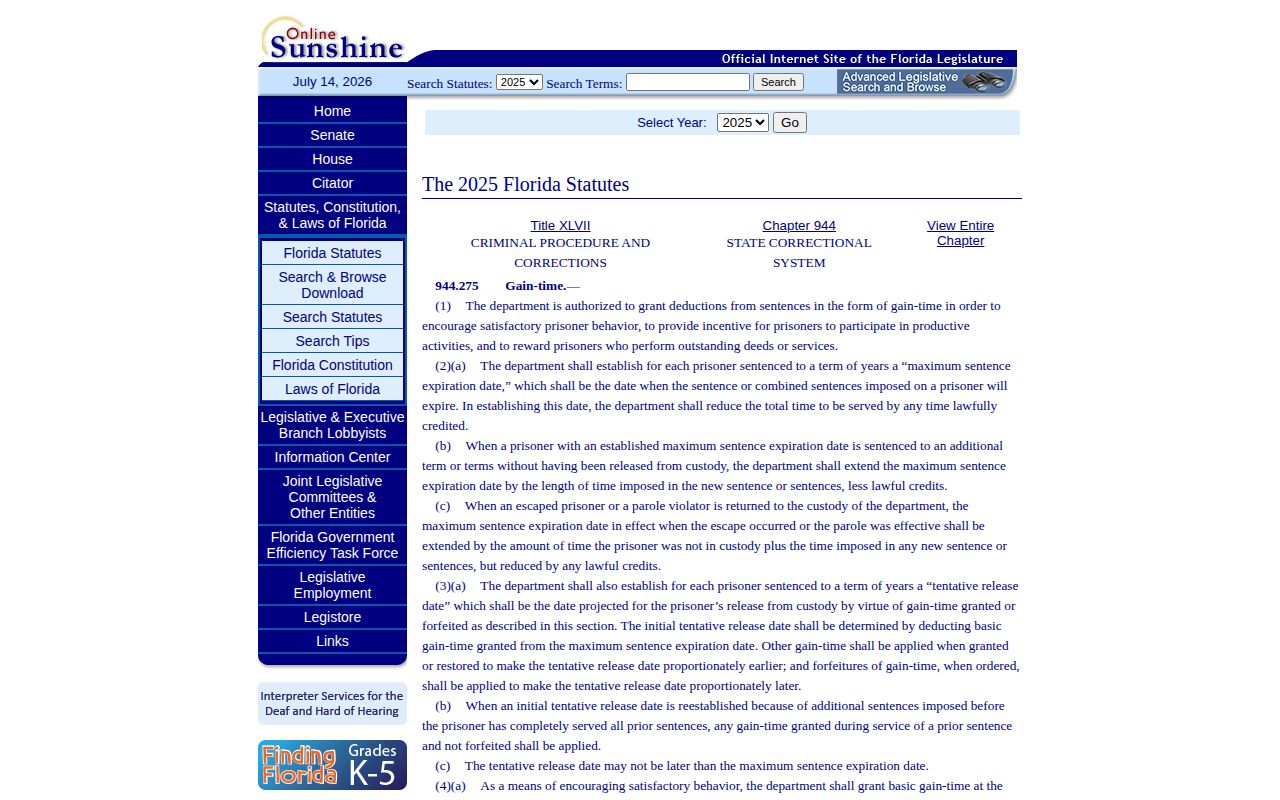
The statute supplies the framework, while FDC applies the person’s actual sentence, credits, exclusions, and disciplinary record.
Walton County Jail Gain-Time
Walton’s county-jail rule is not the FDC formula. Florida Statute section 951.21 permits local good-conduct gain-time policy for county prisoners. Walton’s current handbook states that gain-time is a privilege for sentenced inmates. It is not promised to each pretrial detainee.
The handbook describes up to five days per month for good conduct and up to five days per month for inmate workers. It also discusses limited program and meritorious awards while setting a ten-day monthly maximum. Those parts should not be added beyond the stated cap. Discipline can forfeit credit, and a court order, a new hold, transfer, or a corrected computation can overtake the displayed date.
The county-prisoner gain-time statute establishes the local authority.
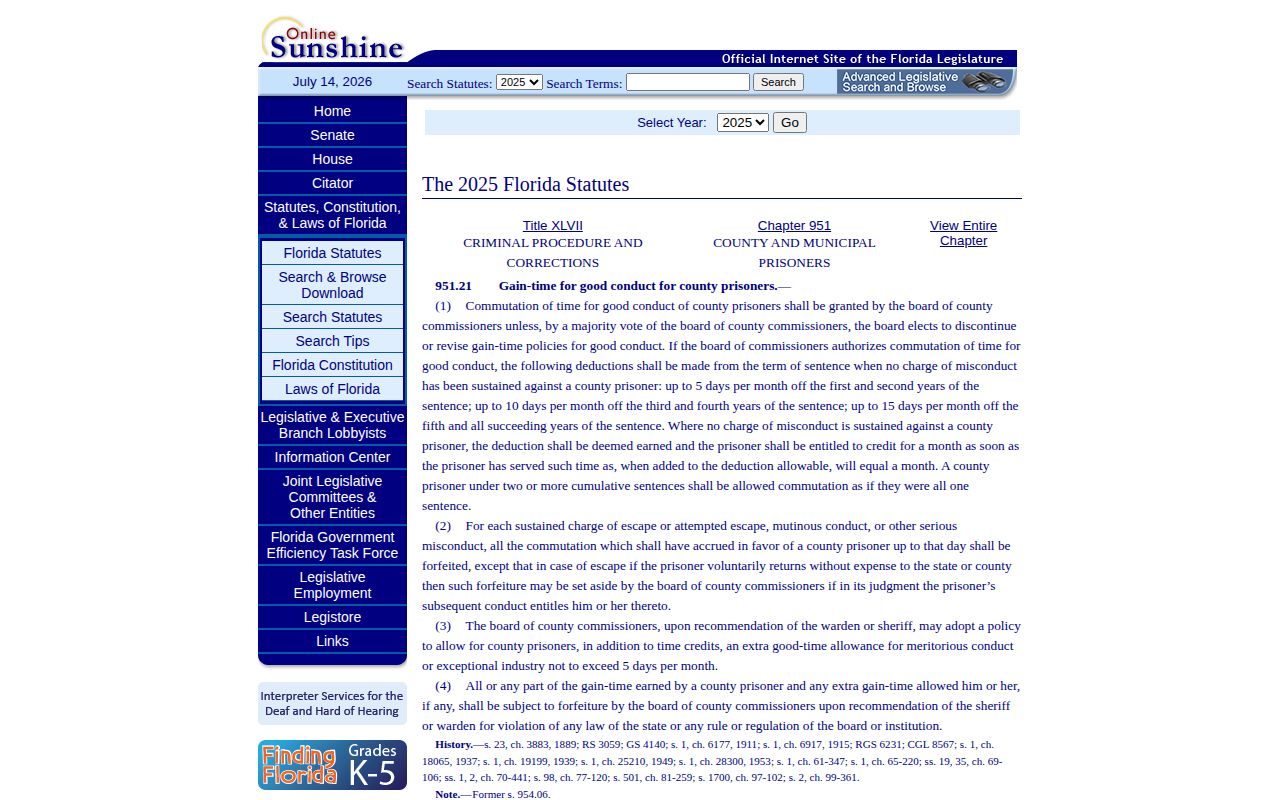
The Walton handbook gives the local policy details, while the Sheriff’s populated Release Date later confirms the booking’s end.
A person-specific county calculation should come from the jail record rather than a hand estimate. Ask for the sentence computation when the displayed date seems inconsistent with the judgment, jail credit, or disciplinary history. Include the booking number and case number. The response can identify which credits were applied without forcing the reader to add handbook award types that may overlap or be subject to the monthly cap.
Note: The state-prison 85-percent framework must not be imposed on every Walton County jail sentence.
Why Walton Release Dates Change
A projected date is a working calculation. Some changes arise from conduct and credits. Others come from a court or another custody system. Reading the factor beside the controlling agency prevents a jail schedule from being confused with an FDC date.
| Factor | Possible effect | Confirm with |
|---|---|---|
| Gain-time award or restoration | May move an eligible date earlier within legal limits | FDC or jail computation |
| Disciplinary forfeiture | May move the date later | Custody record |
| New sentence or corrected credit | Recalculates the term | Court and custody agency |
| Consecutive cases | One term follows another | Judgment and sentence |
| Detainer or hold | May lead to another custodian | Holding and receiving agencies |
| Parole or conditional-release action | May set or revise release and supervision | FCOR and FDC |
FDC’s Bureau of Admission and Release handles state release-data questions at (850) 488-9167 or dc.release@fdc.myflorida.com. County computation questions belong with Walton County Jail or a focused public-record request. One office cannot correct the other system.
Parole adds another distinction. A presumptive or effective parole date arises through FCOR’s process for the limited eligible population. It is not the same as FDC’s gain-time date. A hearing can revise or defer action, and an eligibility interview is not a release. Read the Commission order, then verify the later custody record and any supervised-population entry.
Confirm Walton County Actual Release
Once the date arrives, return to the historical record. In WCSO’s inquiry, uncheck In Custody, find the person, choose the correct Booking History entry, and read Release Date with the disposition. In FDC, use the release-information search and compare Date Out-Custody and sentence details. A future field should not be relabeled as an actual departure.
Florida VINE can send a custody-change alert for Walton County Jail and FDC, but its data are supplied by the custody agency. Verify the notice through that source. The VINE Inmate Check explains the one-person registration route. For a complete county search and records fallback, use the Walton County released inmates lookup.
When no web result resolves the question, ask WCSO for the release date, time, method or disposition, and receiving agency for the identified booking. For FDC, request the release computation or public release record by DC number. Clear identifiers reduce mistaken matches and keep the response focused.
Nightly or weekly update statements must stay tied to the source that published them. FDC says release dates and location changes update nightly in its relevant databases. WCSO publishes no guaranteed web-refresh pace. A same-day county absence therefore calls for jail confirmation, not an assumption that the Florida prison cadence applies to the Sheriff’s system.